Quick answer: Breathing exercises practised in yoga classes for pregnant women—such as diaphragmatic breathing, slow deep breathing, and counted breathing—can support relaxation, reduce anxiety, and help expectant mothers stay calmer during contractions. These techniques are most effective when learned under qualified prenatal yoga guidance.
Labour is one of the most physically and emotionally demanding experiences a woman can go through. For many first-time mothers, the uncertainty around pain and how the body will respond can feel overwhelming. One question that comes up repeatedly in prenatal wellness conversations is: “Is there anything I can actually do to prepare?”
The answer, according to a growing body of midwifery and yoga research, points strongly toward breathwork. Controlled, intentional breathing is one of the most accessible tools an expectant mother has—and when it is practised regularly through structured yoga classes for pregnant women, it can become a reliable anchor during the intensity of labour.
This blog explores why breathing matters so much during labour preparation, which simple techniques are safe to practise, and how professional prenatal yoga classes can give you the structured support to practise them correctly. If you have any existing pregnancy complications or have been advised to limit physical activity, please consult your obstetrician or gynaecologist before beginning any prenatal exercise programme.
Why Does Breathing Matter During Labour Preparation?
When the body senses pain or stress, it responds by activating the sympathetic nervous system—commonly known as the “fight or flight” response. Breathing becomes shallow, muscles tighten, and anxiety can escalate. During labour, this cycle can make contractions feel more intense and harder to manage.
Intentional breathing activates the parasympathetic nervous system instead. This is the body’s “rest and recover” mode. Slow, controlled breaths signal safety to the nervous system, helping muscles soften, the heart rate settle, and the mind stay focused rather than reactive.
Regular practice of breathing techniques during pregnancy builds a kind of muscle memory. When labour begins, the breath becomes something the body already knows how to use. This is precisely why breathing is not just a relaxation tip—it is a fundamental labour preparation exercise.
How Prenatal Yoga Can Help You Practise Better Breathing
Prenatal yoga classes integrate breathwork into every session. Unlike reading about techniques online, a live class—whether in-person or online—gives expectant mothers the chance to practise breathing in real time, with feedback from a qualified instructor.
In yoga classes for pregnant women, breathwork (pranayama) is typically woven alongside gentle movement and relaxation. This means breathing is never practised in isolation. Instead, it is connected to posture, body awareness, and mental focus—which is much closer to how breathing will need to function during actual labour.
Practising regularly in a structured prenatal yoga setting also builds consistency. Even 30 to 60 minutes of guided practice, two to three times a week, can make breathwork feel natural and automatic by the time labour begins.
Simple Breathing Exercises for Pregnant Women
The following breathing techniques are commonly introduced in yoga classes for pregnant women. They are gentle, beginner-friendly, and appropriate for most stages of pregnancy. Always check with your healthcare provider before starting any new exercise, especially in the third trimester or if you have a high-risk pregnancy.
Diaphragmatic (Belly) Breathing
What it is: Diaphragmatic breathing means breathing deeply into the belly rather than into the chest. It engages the diaphragm—the primary breathing muscle—more fully.
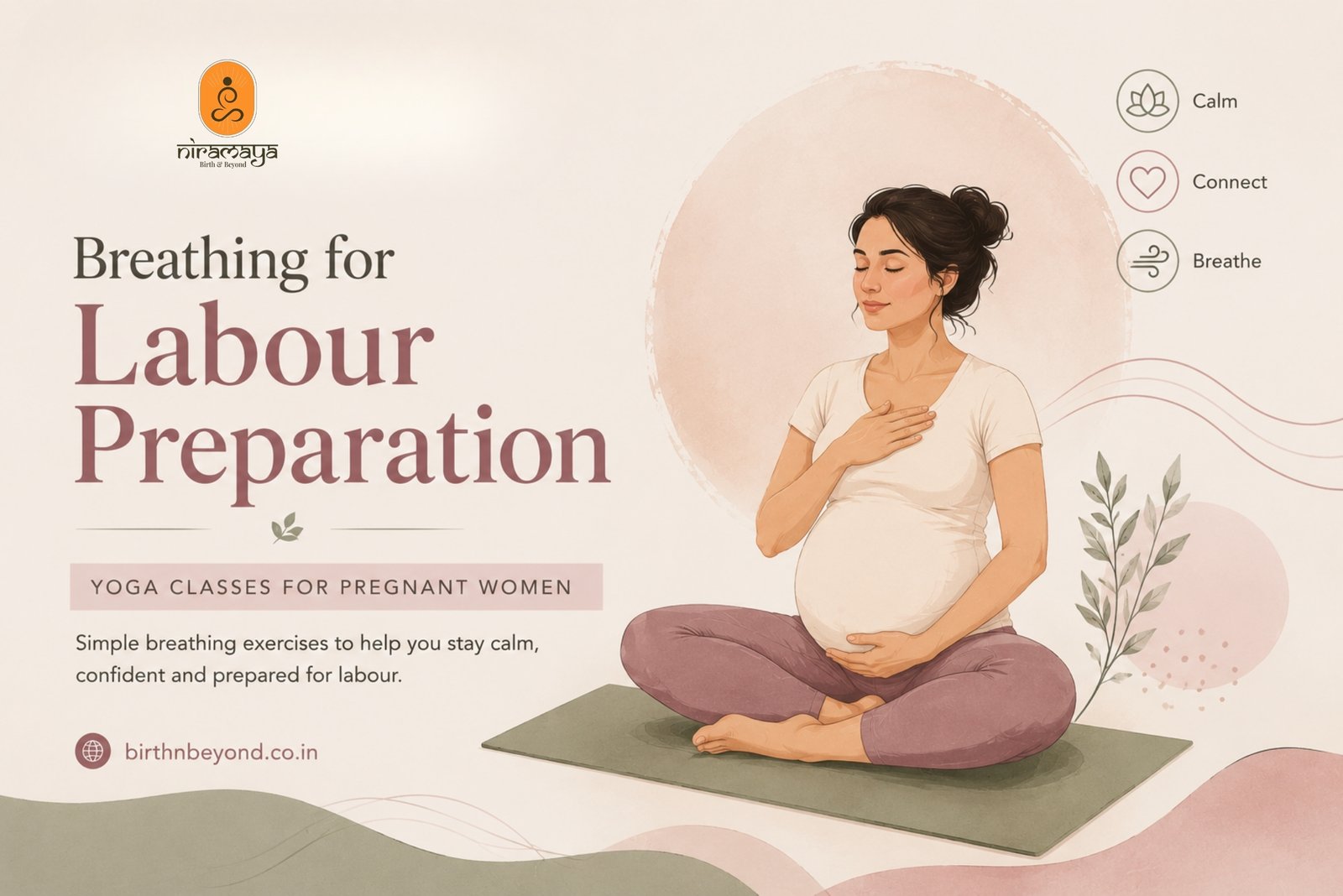
How to practise it: Sit comfortably or lie on your left side. Place one hand on your chest and one on your belly. As you inhale slowly through the nose, allow the belly to expand outward. The chest should remain relatively still. Exhale gently through the mouth or nose, allowing the belly to soften inward. Practise for 5 to 10 breaths at a time.
How it supports labour preparation: Diaphragmatic breathing directly activates the parasympathetic nervous system. With regular practice, it becomes one of the most instinctive ways to calm the body during a contraction.
For beginners: Focus on making the exhale slightly longer than the inhale. This lengthened exhale is what signals the nervous system to relax.
Slow Deep Breathing
What it is: A rhythmic pattern of slow, deliberate inhalation and exhalation, without any breath retention.
How to practise it: Inhale through the nose for a count of four. Exhale through the mouth or nose for a count of six or eight. Keep the breathing smooth and unconstricted. Repeat for several rounds.
How it supports labour preparation: Slow deep breathing reduces heart rate and lowers cortisol levels. During early labour, it can help a woman stay grounded and conserve energy for active labour phases.
For beginners: Do not force a specific count if it feels unnatural. Start with whatever rhythm feels comfortable, then gradually extend the exhale as practice continues.
Counted Breathing
What it is: A focused technique where the breath is paired with counting to anchor the mind.
How to practise it: Inhale for a count of four, hold gently (without strain) for a count of two, then exhale for a count of six. Adjust the counts to whatever feels comfortable. The aim is to keep attention on the numbers rather than on discomfort or anxiety.
How it supports labour preparation: The cognitive focus required by counted breathing gives the mind something structured to do during contractions. This can reduce the perception of pain and prevent panic from setting in.
For beginners: Avoid any breath retention if it causes discomfort. A simple inhale-exhale pattern with counting works just as well.
Relaxation Breathing (Sighing Exhale)
What it is: A simple, open-mouthed sigh-like exhale following a deep inhalation. This is one of the most natural and spontaneous ways the body releases tension.
How to practise it: Take a full, comfortable inhale through the nose. Open the mouth slightly and let the breath fall out with a soft “haaa” sound, releasing any jaw tension, shoulder tension, or gripping in the body. Allow the exhale to be completely passive—do not force it out.
How it supports labour preparation: The relaxation breath is particularly useful during the peak of a contraction, when tension naturally escalates. The audible, open exhale also helps relax the pelvic floor, which is important during labour.
For beginners: Practise this in a seated or lying position. Let go of any self-consciousness about the sound—the release is exactly the point.
Gentle Exhalation-Focused Breathing
What it is: A style of breathing where the primary intention is to lengthen and soften the exhale, without controlling the inhale.
How to practise it: Breathe in naturally through the nose. On the exhale, allow the breath to flow out slowly and completely, as if gently deflating. Do not rush to inhale again. Let the inhale arise on its own, then repeat.
How it supports labour preparation: This technique encourages the body to shift into a resting state between contractions. It also prevents the habit of shallow, chest-based “panic breathing” that many women default to under stress.
For beginners: This is an excellent technique to practise at night before sleep, as it naturally encourages the body to wind down.
How to Practise Breathing Exercises During Pregnancy
Consistency matters more than duration. Even five to ten minutes of focused breathwork each day can build meaningful body awareness over the course of a pregnancy. Here are some practical guidelines:
- Choose a comfortable position. Sitting cross-legged, sitting in a chair, or lying on your left side all work well. Avoid lying flat on your back for extended periods in the second and third trimesters.
- Practise in a quiet space. Reducing auditory distraction helps the nervous system settle more easily during initial practice.
- Breathe through the nose where possible. Nasal breathing filters, warms, and slows the breath naturally. Mouth breathing is appropriate for some exhalation techniques.
- Stop if you feel dizzy, breathless, or uncomfortable. Breathwork should never cause strain. Ease off and return to normal breathing if anything feels wrong.
- Pair breathing with movement. Prenatal yoga classes for pregnant women offer the ideal environment for this, as instructors integrate breath with posture and body awareness throughout each session.
How Breathing Techniques May Help During Contractions
Contractions are intense, rhythmic, and time-limited. Breathing that is practised regularly before labour gives the body a familiar rhythm to return to when contractions begin.
During early labour, slow deep breathing and counted breathing can help a woman stay calm and paced. As labour progresses and contractions intensify, relaxation breathing and diaphragmatic breathing become useful anchors. Between contractions, gentle exhalation-focused breathing allows the body to reset and recover.
None of these techniques eliminate discomfort. What they do is offer the nervous system a manageable, familiar pattern to follow—which changes the experience of labour meaningfully for many women. The degree to which breathing helps will vary from person to person and from labour to labour. Regular, committed practice before labour is what makes these techniques genuinely available in the moment.
Benefits of Learning Breathing Techniques in Prenatal Yoga Classes
Practising at home using videos or articles has value—but it has real limits. In a professional prenatal yoga setting, the benefits extend considerably further:
- Real-time correction: An instructor can observe your posture, breathing pattern, and any signs of strain, and adjust accordingly.
- Progressive learning: A well-structured programme builds from foundational techniques in early pregnancy to more labour-specific practices in the third trimester.
- Community: Practising alongside other expectant mothers creates a sense of shared experience and peer support that online self-practice cannot replicate.
- Integration: Prenatal yoga classes combine breathing with movement, relaxation, and mindfulness—creating a holistic preparation approach rather than isolated technique drills.
- Safety: Qualified instructors understand which techniques and positions are appropriate at each stage of pregnancy, reducing the risk of over-exertion or incorrect practice.
Safety Tips Before Practising Pregnancy Breathing Exercises
- Always get clearance from your obstetrician or gynaecologist before starting any new prenatal exercise programme.
- Avoid prolonged breath retention, forceful breathing techniques (such as Kapalabhati or Bhastrika), or any advanced pranayama not specifically cleared by a qualified prenatal instructor and your healthcare provider.
- Stop any technique immediately if you feel lightheaded, short of breath, experience chest tightness, or feel pressure in the pelvic area.
- In the third trimester, prioritise comfort. Not every breathing position that worked in the first trimester will be appropriate later.
- Drink water before and after breathing sessions.
Why Choose Professional Yoga Classes for Pregnant Women?
Online search results are full of pregnancy yoga videos and breathing technique guides. Many are genuinely helpful. But pregnancy is a deeply individual experience, and a qualified prenatal yoga instructor brings something no algorithm can: the ability to see, respond to, and support the specific woman in front of her.
Professional yoga classes for pregnant women are structured to progress safely through each trimester. They account for common pregnancy conditions, physical changes, and the emotional complexity of expecting a child. An experienced instructor will also know when to modify, pause, or refer a participant back to her healthcare provider.
For first-time mothers especially, the reassurance of practising in a guided, professional setting—surrounded by other expectant women—can be profoundly grounding.
Why Birth & Beyond Can Be a Supportive Choice for Pregnancy Wellness
Birth & Beyond offers yoga classes for pregnant women through its Niramaya yoga programme, led by Neeru—a seasoned Hatha and Ashtanga yoga practitioner with over 30 years of dedicated practice and teaching. Her approach integrates asanas, pranayama (breathing), and meditation, with a particular focus on the holistic needs of expectant mothers.
Classes are available both online and in-person, across two locations in Chandigarh and Panchkula. Pre-natal timings are structured across the week to accommodate different schedules. The first session is complimentary, which allows expectant mothers to experience the environment and approach before committing.
What distinguishes Birth & Beyond is the depth of experience behind the programme. Neeru’s three decades of practice mean that prenatal yoga at Birth & Beyond is grounded in genuine expertise—not simply adapted general yoga. The community at Birth & Beyond is also described by its members as nurturing and connected, which matters enormously for expectant mothers navigating this significant life transition.
If you are looking for structured, professional pregnancy yoga support in Chandigarh or Panchkula—or online from anywhere across India—Birth & Beyond is worth exploring. Reach out through the Yoga for All page to understand the available options and find an approach suited to your stage of pregnancy.
You can also find Birth & Beyond on Google by searching “Birth & Beyond Chandigarh” or “prenatal yoga Panchkula.” Their Google Business Profile lists location details, class information, contact numbers, and genuine reviews from women who have experienced the programme firsthand—useful before making any enrolment decision.
Frequently Asked Questions
Is it safe to practise breathing exercises during pregnancy?
For most healthy pregnancies, gentle breathing exercises such as diaphragmatic breathing and slow deep breathing are safe. However, forceful techniques or prolonged breath retention should be avoided unless specifically approved by a qualified prenatal yoga instructor and your healthcare provider. Always consult your obstetrician before beginning any new prenatal exercise practice.
When should I start breathing exercises during pregnancy?
Breathing exercises can generally be introduced from the first trimester onward, with your doctor’s clearance. Many prenatal yoga classes begin breathwork from 12 to 14 weeks, though the techniques and intensity are adjusted as pregnancy progresses. Starting earlier gives more time to build familiarity before labour.
Can breathing exercises guarantee a normal or pain-free delivery?
No. Breathing exercises support relaxation, reduce anxiety, and may help women manage contractions more effectively—but they cannot guarantee any specific labour outcome, including a normal delivery or a pain-free experience. Labour is influenced by many physiological and individual factors. Breathing practice is one supportive tool among many.
What makes prenatal yoga breathing different from regular breathing exercises?
In prenatal yoga classes for pregnant women, breathing techniques are specifically chosen and adapted for the safety and needs of pregnancy. Positions are pregnancy-appropriate, intensity is carefully managed, and qualified instructors guide real-time adjustments. This differs significantly from general breathing exercises or non-specialised yoga classes, which may not account for trimester-specific changes or pregnancy complications.
Take the Next Step Toward Professional Prenatal Support
Breathing is something every woman already does. The goal of prenatal yoga is to make that breath purposeful, accessible, and reliable—long before labour begins.
If you are exploring structured yoga classes for pregnant women in Chandigarh, Panchkula, or online, the Birth & Beyond team welcomes you to learn more about what their prenatal yoga programme involves. Your first session is complimentary, and the team is available to answer any questions about what approach best suits your stage of pregnancy and individual needs.
Visit the Yoga for Pregnant Women page at Birth & Beyond to explore available classes, timings, and locations—and take a well-informed next step toward pregnancy wellness.